You are currently viewing Why Is Your Hair Growing Slowly? Let’s Understand First
Why Is Your Hair Growing Slowly

Why Is Your Hair Growing Slowly? Let’s Understand First

Understanding the problem

Before we talk about oils, it's important to understand what's actually causing your hair fall or slow growth. Most people jump straight to buying a new oil or shampoo — but if you don't know the root cause (literally), no oil will give you lasting results.

Hair grows from follicles in your scalp. These follicles need proper blood circulation, nutrients, and a clean, healthy scalp environment to produce strong hair. When any of these are missing, hair either grows slowly, breaks easily, or falls out at the root.

🥗
Poor nutrition
Low iron, protein, zinc, or Vitamin D weakens hair from the inside out
😓
Stress
High cortisol pushes follicles into a resting phase, causing shedding
💧
Dry scalp
A dehydrated scalp can't support healthy follicles — leads to breakage
❄️
Dandruff
Fungal buildup blocks follicles and slows growth significantly
⚗️
Hormones
PCOS, thyroid issues, or post-pregnancy shifts trigger major hair fall
🧪
Harsh products
Sulfate shampoos & chemical treatments strip moisture and damage roots

A good hair oil works by improving scalp circulation, delivering nutrients directly to the roots, and creating a protective barrier that reduces breakage. That's exactly why consistent oiling — done the right way — produces real, visible results over time.


The best oils ranked

Best Hair Oils for Hair Growth — Ranked & Explained in Detail

Not all hair oils are the same. Some work by conditioning, some by stimulating growth, and some by healing the scalp. Here's a thorough breakdown of the most effective options — what each one does, who it's best for, and how to use it properly.

01
Classic & proven
Coconut Oil — The All-Time Classic
Best for deep conditioning, protein protection & all hair types
All hair types Most popular Scientifically proven

Coconut oil is one of the very few oils that has been scientifically proven to actually penetrate the hair shaft, rather than just coating the outside. Studies show it significantly reduces protein loss from both undamaged and damaged hair. It's packed with lauric acid which has a high affinity for hair proteins — meaning it bonds with your hair and protects it from within, not just on the surface.

Pure, cold-pressed virgin coconut oil is your best bet. Avoid refined, bleached, or deodorised versions — they lose most of the beneficial properties during processing. If your hair is fine or tends to get weighed down, use a smaller amount and focus mainly on the scalp and roots, letting it work where it matters most.

How to use it right: Warm a small amount between your palms, massage into the scalp using circular motions, then work it through the length of your hair. Leave for at least 2 hours or overnight for best results, then wash with a gentle shampoo. Repeat 2–3 times per week.
02
Growth stimulator
Castor Oil — The Hair Growth Powerhouse
Best for thinning hair, bald patches & heavy hair fall
Stimulates growth Very thick texture Rich in ricinoleic acid

Castor oil is the go-to solution when people are dealing with serious hair fall or thinning. Its main active compound — ricinoleic acid — improves blood circulation to the scalp and creates a better environment for hair follicles to function. Better circulation means more nutrients reaching the roots, which directly supports faster, thicker hair growth over time.

It's also a natural humectant, meaning it draws moisture from the air into your hair and scalp. This keeps the scalp hydrated and reduces the dryness that often contributes to hair breakage. Many people apply castor oil specifically to thinning areas, hairlines, or eyebrows and see real, measurable results with consistent use over 8 weeks.

The downside is that pure castor oil is extremely thick and sticky, which makes it hard to apply evenly and wash out cleanly. The simple fix is to always mix it with a lighter carrier oil before applying.

Pro mixing tip: Combine 1 part castor oil with 2 parts coconut or almond oil. This makes it far easier to spread across the scalp without the heavy, sticky feeling. Apply to scalp only, leave overnight, wash off the next morning.
03
Ayurvedic classic
Bhringraj Oil — The Ayurvedic King of Hair
Best for hair fall, premature greying & scalp nourishment
Ayurvedic herb Slows greying Strengthens roots

Bhringraj, also known as Eclipta Alba or "false daisy", has been used in Ayurveda for over 2,000 years as the single most powerful herb for hair health. The name itself — Bhringraj — translates to "king of hair" in Sanskrit, and that title has been earned over centuries of documented use.

Modern research has actually backed up many of these traditional claims. Studies show that Bhringraj extract promotes hair follicle activity and can help prevent hair loss at a cellular level. It also has strong anti-inflammatory and anti-fungal properties that keep the scalp clean and healthy — which is essential for unobstructed, consistent hair growth.

Bhringraj is also one of the few natural remedies traditionally used to slow down premature greying. Regular use is said to improve melanin production in hair follicles, helping maintain natural hair colour for longer. If grey hair is a concern alongside hair fall, Bhringraj-based oils specifically address both issues simultaneously.

Best method: Massage warm Bhringraj oil into the scalp at night and wrap hair in a warm towel for 30 minutes to boost absorption. Leave overnight and wash off in the morning. Real results typically appear after 8–12 weeks of consistent use.
04
Light & repairing
Almond Oil — Perfect for Dry & Damaged Hair
Best for dry, brittle, chemically or colour-treated hair
Lightweight Vitamin E rich Repairs damage

Sweet almond oil is perhaps the most underrated hair oil in the market. It's light enough to use daily without weighing hair down, yet rich enough in Vitamin E, magnesium, and Omega-9 fatty acids to genuinely repair and strengthen damaged hair. If your hair is dry, frizzy, or has been through a lot of chemical processing — bleaching, perming, relaxing, or even frequent heat styling — almond oil is exactly what it needs.

Vitamin E in almond oil acts as a powerful antioxidant that reduces oxidative stress on the scalp — a key but often overlooked factor in hair thinning. Magnesium is equally important; magnesium deficiency is actually a documented cause of hair loss, and almond oil delivers it directly to the scalp where it's most needed.

Unique usage tip: Almond oil is light enough to be used as a leave-in treatment. Apply a few drops to damp hair after washing to seal moisture and reduce frizz — no need to wash it out. It doubles as both a scalp treatment and a finishing oil.
05
Scalp healer
Neem Oil — The Scalp Saviour
Best for dandruff, itchy scalp, fungal infections & blocked follicles
Anti-fungal Anti-bacterial Strong smell — dilute well

If dandruff or an irritated scalp is your main hair concern, neem oil is the most powerful natural solution available. Neem contains a compound called azadirachtin which is a potent anti-fungal agent — it directly targets the Malassezia fungus responsible for most cases of dandruff. It also has anti-bacterial properties that clear scalp infections and reduce the inflammation that blocks follicles and causes hair loss.

The key with neem oil is to always dilute it before applying. Pure neem oil is extremely concentrated and can cause skin irritation when applied undiluted. Mix it with coconut oil in a 1:5 ratio — one part neem to five parts coconut — and you'll get all the therapeutic benefits without any irritation or discomfort.

Smell tip: Neem has a very strong, pungent smell that many people find unpleasant. Adding a few drops of peppermint or tea tree essential oil to your neem-coconut mix helps neutralise the smell while adding extra scalp-soothing benefits at the same time.
Ayurvedic All hair types Men & women 81-day preparation

Let's be honest — the word "Ayurvedic" gets thrown around a lot on hair oil labels today. Most of them are simply regular coconut or mineral oils with a few dried herbs added and a traditional-sounding name printed on the bottle. They're not necessarily bad products, but they're not Ayurvedic in any genuine sense of the word.

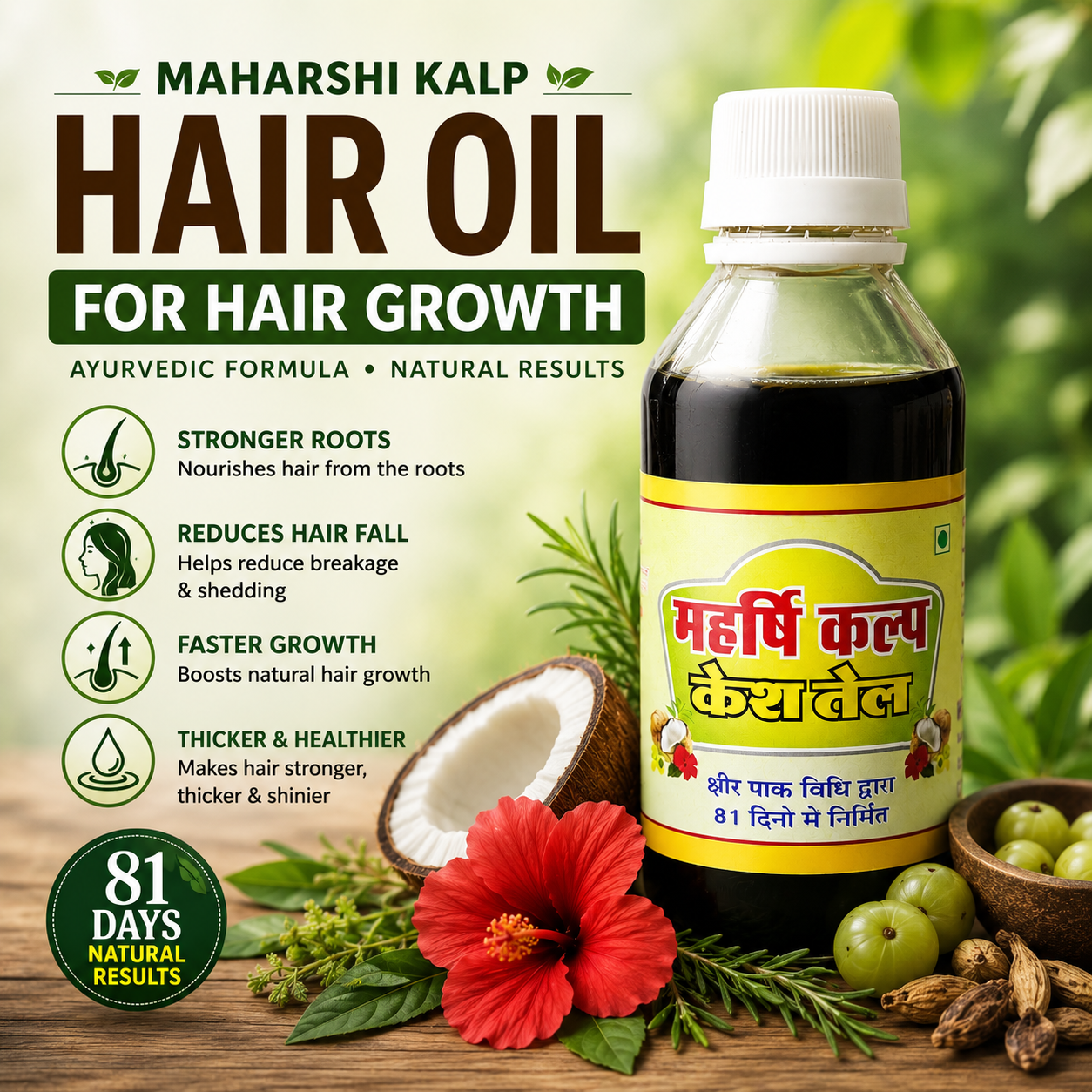
Maharshi Kalp Kesh Tel is different. It is prepared using the Ksheer Pak Vidhi — a classical Ayurvedic preparation method that involves slowly cooking a precise combination of medicinal herbs in both milk and coconut oil over a period of 81 days. This is not a marketing claim or a packaging gimmick. This ancient slow-cooking process exists because it genuinely produces a far more potent and bioavailable product.

When herbs are slow-cooked in oil over weeks, the fat-soluble active compounds from the herbs fully transfer into the oil itself. You're not getting a little herbal flavour in your coconut oil — you're getting an oil where every single drop is loaded with the medicinal properties of all those herbs combined. The milk in the process also acts as a medium that extracts water-soluble compounds, which a pure oil-based infusion would miss entirely.

The result is an oil that goes well beyond surface-level conditioning. It penetrates the roots, nourishes at a cellular level, reduces hair fall, controls dandruff, treats scalp dryness, and repairs split ends — all at once. It's the kind of product that addresses your hair holistically rather than targeting one problem at a time, which is exactly what genuine Ayurveda is designed to do.

What is Ksheer Pak Vidhi? It's one of the most ancient and revered oil preparation methods in classical Ayurveda. Medicinal herbs are combined with milk and base oil in precise ratios, then slow-cooked at low heat for 81 days. This long preparation binds the herbal actives deeply into the oil — creating a far more potent formula than any quick-infused or blended oil. Traditionally, this method was used to prepare medicinal oils for royalty and trained Ayurvedic physicians (vaidyas).
For best results: Warm the oil slightly and massage into the scalp in circular motions for 10 minutes. Leave overnight for deep nourishment and wash off with a mild herbal shampoo the next morning. Use at least 2–3 times per week consistently for 8–12 weeks to see the full benefit.

Technique matters

How to Oil Your Hair Correctly — Step by Step

Even the best oil will give you disappointing results if you're using it the wrong way. Most people apply oil too quickly, don't massage properly, or wash it out too soon. Here's how to do it right and actually get the results you're hoping for:

  1. Warm the oil slightly. Pour a small amount into a bowl and warm it by placing the bowl in hot water for 2–3 minutes. Warm oil has significantly better absorption and penetrates the scalp more effectively than cold oil. Do not microwave or overheat — it should feel pleasantly warm, not hot, when you dip a finger in.
  2. Part your hair into clear sections. Don't just pour oil on top of your hair. Part it into 4–6 sections and apply the oil directly to the scalp along each parting line. This ensures even coverage and proper root nourishment, rather than just surface coating on top of your hair strands.
  3. Massage for at least 5–10 minutes without skipping. Use your fingertips — not nails — to massage the scalp in firm, circular motions. This step is absolutely crucial. The massage itself stimulates blood circulation to the follicles, which directly accelerates hair growth. Many people apply oil and simply go to bed without massaging, which wastes most of the potential benefit.
  4. Work the remaining oil through the lengths and ends. After the scalp is done, use the remaining oil on your fingertips to lightly coat the mid-lengths and ends of your hair. This prevents split ends and breakage, and keeps the hair shaft smooth and strong between washes.
  5. Leave it on long enough to actually work. For a regular treatment, leave oil in for at least 1–2 hours. For a deep nourishment session, leave it overnight. The longer it stays, the deeper the absorption. Wrap your hair in a warm towel after application — the gentle heat helps open the cuticle and boosts nutrient penetration.
  6. Wash off properly with a gentle shampoo. Use lukewarm or cool water — not hot. Hot water strips natural oils and can undo the benefits of your oiling session. You may need to shampoo twice to fully remove heavier oils like castor oil, and that's perfectly fine.
  7. Stay consistent — every single week. Results from hair oiling are cumulative and gradual. Oil 2–3 times per week without skipping. Most people give up after 2–3 weeks because they expect overnight results — but real improvement in hair density, growth, and texture takes 6–12 weeks of dedicated, consistent effort. Patience is your most important ingredient.

Quick reference

Side-by-Side Oil Comparison

Not sure which oil to pick? Here's a clear, honest comparison to help you decide based on your specific hair concern, texture preference, and expected timeline:

Oil Best for Texture Results by Price range
Coconut oil Deep conditioning, all hair Medium 3–4 weeks Low
Castor oil Severe hair fall, thinning Very thick 6–8 weeks Low
Bhringraj oil Premature greying, root strength Medium 8–12 weeks Medium
Almond oil Dry, chemically treated hair Light 2–4 weeks Low–medium
Neem oil Dandruff, scalp infections Light 2–3 weeks Low
Maharshi Kalp Kesh Tel All-in-one complete hair care Medium 3–4 weeks Premium

Common questions answered

Frequently Asked Questions About Hair Oils

Which oil is actually the best for fast hair growth?
There's no single magic oil — but oils with strong scalp-stimulating properties like castor oil and Bhringraj-based Ayurvedic oils have the most research backing for promoting hair growth. If you want a complete solution that addresses multiple issues at once, a traditionally prepared Ayurvedic oil like Maharshi Kalp Kesh Tel is the most comprehensive option available.
Can I use hair oil every single day?
Daily oiling can lead to product buildup on the scalp and clogged follicles if not washed out regularly. For most people, 2–3 times per week is the ideal frequency. Those with very dry scalps or coarse hair can oil more often, but should use smaller amounts and always ensure it's washed out thoroughly. Over-oiling without washing is counterproductive.
How long does it take for hair oil to actually show results?
Most people notice a visible reduction in hair fall within 3–4 weeks of regular oiling. Improvements in hair thickness, density, and length take longer — typically 8–12 weeks. Hair grows approximately 1–1.5 cm per month naturally, so expect gradual progress rather than dramatic overnight transformation. Consistency is the single most important factor in getting results.
What exactly makes a real Ayurvedic hair oil different?
A genuinely Ayurvedic hair oil is prepared using traditional classical methods like Ksheer Pak Vidhi, where herbs are slow-cooked in oil over many weeks. This process allows the active compounds from the herbs to fully transfer into the oil. Most products labelled "Ayurvedic" in the market are simply regular oils with a few herbs mixed in — which is very different in terms of potency. Always look at how the oil was prepared, not just what ingredients are listed.
Is Ayurvedic hair oil safe for coloured or chemically treated hair?
Yes, in most cases. Genuinely prepared Ayurvedic oils are free from harsh chemicals and are gentle enough for chemically treated or colour-treated hair. They actually help repair and strengthen hair that has been weakened by chemical processes. The one exception: avoid applying any heavy oil immediately before a colour treatment session, as it can act as a barrier that affects colour absorption.
Can men use these same hair oils too?
Absolutely. Hair follicles function the same way regardless of gender, and all the oils discussed in this article work equally well for men and women. Products like Maharshi Kalp Kesh Tel are specifically formulated for both. Men dealing with receding hairlines, general thinning, or a dry scalp benefit greatly from consistent oiling, and many see results in the same timeframe as women.
Should I oil before or after washing my hair?
Always oil before washing — never after. Apply oil to dry or slightly damp hair before a wash session. This gives the oil time to nourish the scalp and hair, and the shampoo then cleans away the excess. Applying oil to wet, freshly washed hair is largely ineffective as the hair's cuticles are temporarily raised and the oil won't absorb properly.

Our Final Verdict — What You Should Do Next

Hair growth is a slow, cumulative process — but the right oil, used consistently and correctly, makes a genuinely significant difference. Every oil in this guide is proven in its own way: coconut oil for conditioning, castor oil for growth stimulation, Bhringraj for Ayurvedic nourishment, almond oil for repair, and neem oil for scalp healing.

If you want one oil that covers everything — hair fall, dandruff, dryness, split ends, and overall growth — a traditionally prepared Ayurvedic formula is your best bet. Maharshi Kalp Kesh Tel stands out because it's one of the very few oils still made using the authentic 81-day Ksheer Pak Vidhi process, which makes it genuinely more potent than the standard herb-infused oils you'll find almost everywhere else.

Whatever oil you choose — be patient, be consistent, and always massage properly every single time. Your hair will respond. It just needs time, the right oil, and your dedication.

Leave a Reply